Bangladesh often draws attention as an example of development success, with extensive literature exploring its poverty dynamics and underlying drivers. The country managed to more than halve its poverty rate and sustain almost consistent year-on-year growth within just half a century since independence.(Global Development Institute, 2024). Over the last twenty-two years, the poverty headcount ratio has fallen from 31.1% (2000) to 18.7% (2022) using the upper poverty lines and from 34.3% (2000) to 5.6% (2022) using the lower poverty line (HIES, 2024) while annual GDP growth rate has risen from 5.3% (2000) to 7.1% (2022) (World Bank, 2024). However, economic growth has increased along with a slow poverty reduction rate and economic growth’s ability to alleviate poverty is weakening, and benefits of growth now reach the poor far less effectively. Progress observed in poverty reduction does not reflect the hidden vulnerability of many people who remain just above the poverty line. A 20% rise in the 2022 income threshold for defining poverty would approximately double the percentage of the population classified as poor and more than double the share categorized as extremely poor (White Paper on State of the Bangladesh Economy).
Rapid and unplanned urbanization is one of the most visible impacts of economic growth observed in Bangladesh. Division cities, especially Dhaka and Chattogram, have emerged as the centers of this transformation, portraying development, growth, and economic dynamism. However, the urban poverty rate has increased to 18.7% in 2023, from 16.3% in 2018, while the rate has slightly fallen in the rural areas. Expansion of the multidimensional poverty rate rose from 16.8% in 2018 to about 18% in 2023 (SANEM, 2023). The Gini coefficient, used to measure inequality, is 0.539 for urban areas compared to 0.446 in rural areas in 2022, which was 0.498 and 0.458 in urban and rural areas, respectively, in 2016 (BBS, 2023).
The essence of the urban poverty paradox is based on the tension between economic advancement and rising urban poverty that causes severe inequality among the city dwellers indicating the failure or economic growth to trickle down evenly Hence, for the millions of city dwellers, migrants, or informal worker, life in the cities still is marked by exclusion, inequality, and insecurity instead of opportunity.
This urges a deeper look at how cities are being developed, who benefits from growth, and what policy pathways can lead to inclusive urban development.
The urban poverty paradox is not a unique feature in Bangladesh, but it is more prominent here. Dhaka, which is home to 26.76% of the country’s total population and 84.97% of its urban population (Population and Housing Census, 2022),, attracts people from all across the country because of its concentration of employment opportunities, public utilities, and better lifestyle. Every day, people move within the country in search of better jobs because it is the main center of economic activity. From 2022 to 2025, the number of people living in Dhaka’s metro area grew by about 9.68% (Macrotrends,2025).This influx of people has given rise to a large number of slums and underserved settlements with poor, crowded, and unsanitary dwellings.
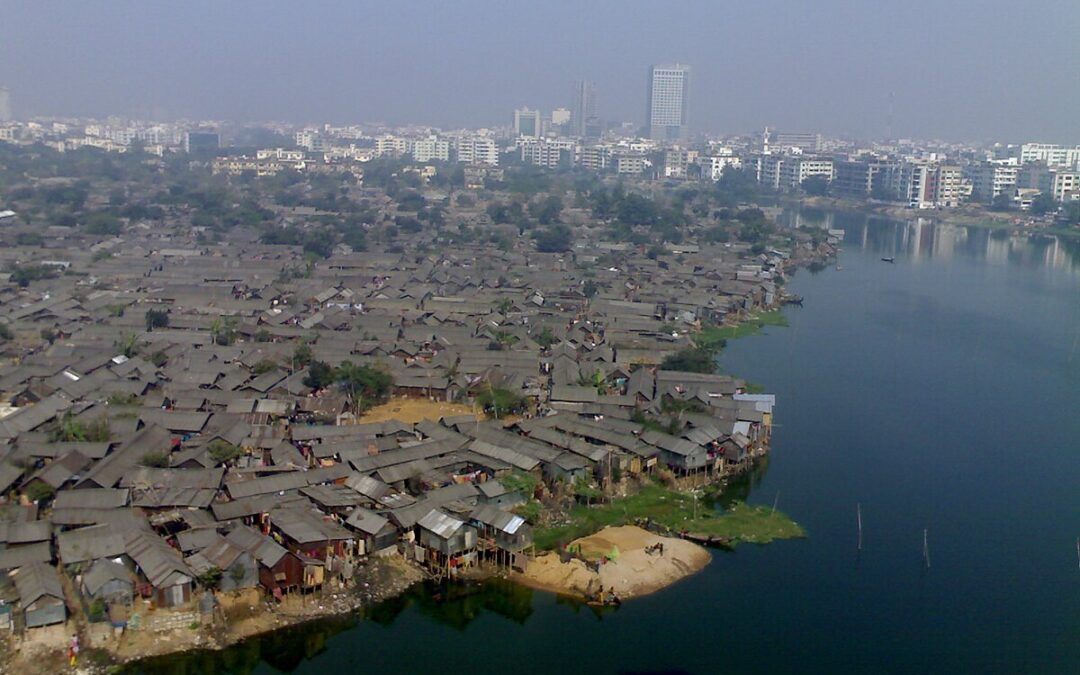
Approximately, 33.63% of slums in Bangladesh are located in the Dhaka division, and about 16% of the slums are in Chattogram, reflecting the dark side covered by absolute urban economic growth (Census of Slum Areas and Floating Populations, 2014). While some urban areas represent royalty in consuming daily necessities, these slum dwellers suffer from very limited access to basic services, i.e., food, secured shelter, electricity, drinking water, basic healthcare, education, and proper employment. Unplanned urbanization puts a lot of stress on existing infrastructure, like waste management, transportation, and sanitation systems leading to excessive pollution, health risk and financial losses. The problem is further worsened by the thousands of displaced individuals who move to cities every year in search of better livelihood possibilities. Each year, on average, 725,000 people are adding in Dhaka’s metro population (Macrotrends,2025). A recent RMMRU study found that Dhaka receives three out of every five (59.2%) migrants from rural areas, with one in five (20.1%) preferring the port city Chattogram. About 94% of Bangladeshis are moving to cities for economic reasons, 59% to get away from social issues, and majority of them live in slums, though some of them live under the open sky (RMMRU,2025)Therefore, increasing urban infrastructure and modern facilities have not necessarily meant upward mobility for the poor; instead, it has redefined poverty and inequality in new forms. The slums in Dhaka, Narayanganj, Gazipur, Chattogram, and other cities tell tales of resilience and deprivation. Strikingly, these are not isolated pockets of poverty, but rather the houses of ready-made garment workers, who contribute to exports, create the city’s infrastructure, and keep all services running, serving as the invisible hands behind visible growth.
Nearly 31.49% of the total population lives in urban areas (Population and Housing Survey, 2022), contributing more than 65% of national GDP (World Bank, 2023). Nonetheless, according to BBS data, one in five urban residents still lives below the poverty line (BBS, 2022) and nearly half of them live in informal settlements with a lack of access to secure housing, sanitation, or clean water (UN-Habitat, 2021). The majority of urban workers are working in the informal economy, which lacks social security, benefits, and legal protection. Domestic workers, transport operators, construction workers and, street vendor are essential to the cities’ economy, yet they are not included in formal safety net programs. They are employed in hazardous, unsupervised environments and receive inconsistent salaries, as well as their contributions remain unappreciated. Being from a low-income family causes them to work at low-paid and unproductive jobs, which further reduces their income and keeps them stuck in a never-ending cycle of low productivity and low income. Even if some of them live above the poverty line, sudden shocks—such as medical emergencies, natural disasters, or job loss—can push them back below it.
Public service distribution in cities of the country is extremely unequal. Residential areas and family income levels largely determine the quality of public infrastructure, healthcare, and education. While low-income communities living in slums and underdeveloped areas face crowded public schools, limited healthcare services, and inadequate public utilities, wealthier households can afford to send their children to private schools, have access to advanced utilities, and receive adequate healthcare in medical emergencies. One glaring example of inequality in Dhaka North is the Banani Lake, which divides the affluent Gulshan neighborhood from the impoverished Korail Slum. A short 10-taka boat ride along the lake unfolds two contrasting realities in parallel. On one side, Gulshan has luxurious housing, modern utilities, and a vibrant lifestyle, while on the other side, Korail suffers from inadequate roads, fragile housing structures, insufficient healthcare, and absence of basic amenities. It would appear that urban governance favors development that eases the life of the rich while neglecting those who are already in a miserable condition. The result is that the cities grow economically but become socially unequal.
One of the major defining features of urban poverty is housing inequality. Approximately 80% of Dhaka’s residents are renters, unable to enter the housing market. The city has a housing shortage of roughly 6 million units, which is expected to increase to 10.5 million units by 2030. The demand for affordable housing is 70%. Unfortunately, only 31,500 units are constructed each year, which is only 1% of what’s required. This leads to a proliferation of slums, such as in Dhaka, where the number of people living in slums increased by 20% between 2010 and 2020. Given that 1.73 million people still reside in slums, sustainable housing solutions are desperately needed (UNDP,2025). Additionally, the Dhaka housing market faces significant obstacles by the underdeveloped financial sector (Farzana,2019). Over the past decades, land prices in urban areas, especially in Dhaka, have skyrocketed, making formal housing unaffordable for most of the low- and middle-income families compelling live under informal settlements or rent tiny, overcrowded rooms in expired, risky buildings andexposing them to eviction, fires, water clogging, and health hazards. Living in informal housing reflects adaptation to exclusion of the marginalized community with an effort to stay connected to the city’s ecosystem even when the city itself refuses to accommodate them.
Education, key to escaping poverty, often reflects severe inequality embedded in urban life. One in six children in Dhaka’s slum, between 6 and 14 years old, do not attend schools, and the dropout rates are particularly prevalent among adolescents, and there is a drastic drop in enrollment from 69% for 10-14-year-olds to just 25% for 15-19-year-olds in urban slums (BRA,2020). The literacy rate among slum residents is only 63.67% (BBS,2024), approximately 15.14% lower than the literacy rate of the country (78.81%), and around 35.21% of the young aged 15-24 years are not in Employment, Education, or Training (NEET) (BBS, 2024). This intergenerational cycle of low education, low productivity, and low income perpetuates poverty, leaving households with little opportunity to improve their socioeconomic condition. On the contrary, urban affluent and upper-middle-class households invest in private schooling and foreign curricula, which enables them to attain better education and later on secure better employment in the future.
A clear gender dimension is also deeply rooted in urban inequality. The lion’s share of the total urban female labor force participation rate (22.59%) belongs to low-income households, mostly residing in the slums. Around 70% of the poverty-stricken urban women are employed in shock-sensitive sectors like the garment industry (42%) and the cleaning sector (28%) (TBS,2023). These women are employed at the cost of low wages, unhealthy working conditions, and limited recognition. The RMG industry, comprised of 16,19,000, or 37.51% women, the country’s largest export earner, does not provide the women fair salary, job security, or maternal benefits (LFS,2022). It remains reluctant to provide workers with their basic rights. Often, the workers go unpaid for months and are compelled to protest merely to claim their due wages.
Slums and informal settlements are home to nearly 51.86% of the country’s urban population, implying that half of the urban residents are living in places where environmental hazards are most concentrated (CEIC,2020). The land surface temperature of Dhaka has increased by an average of 6.43% over the past three decades (1993-2020), exposing the impoverished to intense heat through their jobs as cleaners, rickshaw pullers, construction workers, street vendors, and day laborers (Mosaddek & Ahmed,2025) and recurrent waterlogging in Dhaka severely disturbs slum households in the cities(Nithila et.al.,2022). Even a single hour of heavy rainfall can inundate all the slums in Dhaka. Due to their limited income, lower community participation, and zero political voice to demand compensation, these people are bound to endure such hardships in silence. They are the worst victims of environmental hazards despite contributing the least to their causes.
The urban poverty paradox has repercussions that go beyond individual hardships. Co-existence of higher poverty amid substantial economic growth weakens cities’ resilience and productivity. The ability of the population as a whole to innovate and flourish is weakened when a sizable portion of the population is denied access to basic utilities, steady income, health care, and education.. Cities exist on density and diversity, yet when economic divides lead to spatial segregation, the very social fabric that sustains urban life begins to unravel. Wealthier communities often blame the poor for being the cities’ ill while they bear the heaviest burden of these problems.
Economic growth is not enough to overcome the urban poverty paradox. It demands inclusive governance, redistributive policies, and recognition of the urban poor as active citizens and formalization of the economy Although, complete formalization within overnight is impossible, Bangladesh can adopt some of the successful steps taken by other countries. For instance, Brazil imposed special tax regimes for the Micro and Small Enterprises (MSEs), known as Simples Nacional, to encourage formalization, which resulted in an increased formalization and growth for very small firms (ILO,2019). In India, under the Prime Minister Street Vendor’s AtmaNirbhar Nidhi, street vendors are getting small credit without collateral. Interest subsidies are offered to them for timely repayment. The scheme also promotes digital transactions and cashback incentives for regular use. For legal identification, municipal vending zones and vendor registration systems are used (UMANG,2025). Expanding social protection coverage through flexible contribution schemes, as practiced in Indonesia, among poor urban communities would help include the informal workers in social security programs. Additionally, developing a digital one-stop platform like Ghana’s to connect informal workers with government services, training, and welfare benefits will enhance the process of formalization.
Providing adequate housing in the context of limited land area is a major challenge. Yet, the state must play a proactive role in promoting affordable housing. If new land acquisition is not feasible, redeveloping the existing areas by sustainable urban planning can be an alternative.
To make education more equitable and accessible, cities like Mumbai (India) and Nairobi (Kenya) provide special enrollment facilities, mobile schools, and community-based education centers in slum areas. Dhaka can implement similar initiatives to enhance enrollment and lower economic and geographic barriers. Providing free vocational training to the youth from slums would help them get into the urban labor market. Another way to provide quality education can be establishing low-cost of free internet hubs in the slums to enable children and youth to access online education.
Gender inclusiveness must be a top priority in urban development. Better lighting in the streets, cheaper and women-only transport services, and safe pathways to slum areas are necessary to reduce harassment. Designing women-focused training modules, and providing micro-credit would help them to engage in formal sectors. I
Decentralizing necessary services from the urban centers to municipal rural areas can help reduce excessive pressure on cities. If the people got access to quality education, healthcare services, and decent jobs in their own communities, they would not migrate to the cities in search of better livelihoods.
The urban poverty paradox implies that development cannot be merely measured by GDP or the number of skyscrapers. Instead, it should be judged by the quality of life of those who build the city: the garment workers who send their children to schools for a better future, the rickshaw pullers who endure the city’s chaos, the domestic workers who uphold middle-class comfort, or the indigenous communities who are primarily employed in city maintenance. Their hardships and aspirations form the foundation of urban prosperity enjoyed by the elite society.






























RECENT COMMENTS