
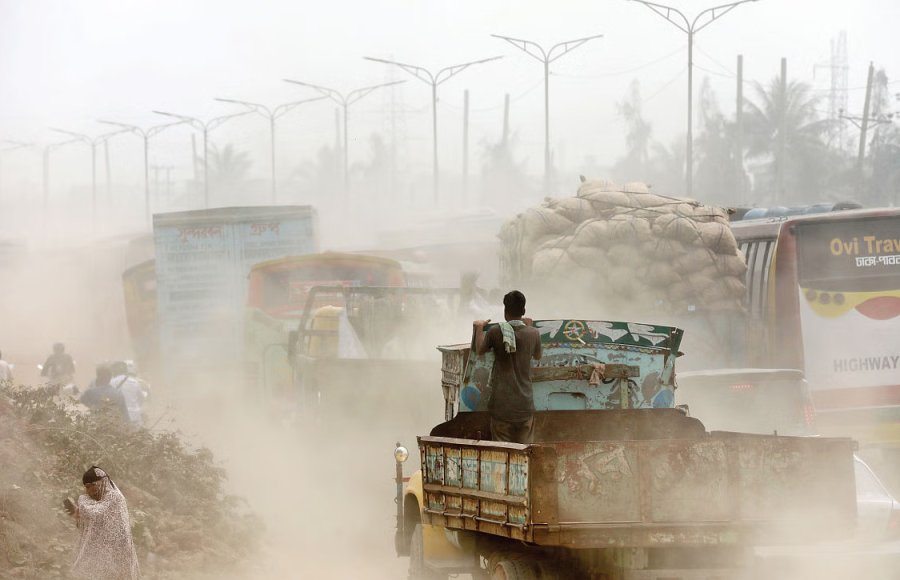
Bangladesh’s transport sector stands at a critical juncture, where the shift to green mobility is no longer a choice but a necessity for climate-focused and sustainable development
Every day, commuters in major cities in Bangladesh navigate heavy traffic, surrounded by toxic exhaust fumes. As the country’s economy grows and urbanization intensifies, the demand for transportation has been rising. It is estimated that 3.2 million two-and-three-wheelers will be added between 2020 and 2050. The expanding transport sector has become a major source of air pollution and Green House Gas (GHG) emissions. The transport sector is responsible for 15% of the country’s total emissions. The heavy reliance on fossil fuels, combined with insufficient public transport infrastructure and limited sustainable alternatives, have led to a rising trend in the CO2 emissions by the transport sector in Bangladesh.
As a signatory to the Paris Agreement, Bangladesh has been taking proactive measures to reduce its emission levels. A key element of this activity is the development of Nationally Determined Contributions (NDCs), which Bangladesh has been preparing since 2015. At COP30 held in Brazil this year, Bangladesh has presented its third NDC, a political document outlining its commitment for moving towards a sustainable future. The transport sector, a central component of Bangladesh’s climate strategy, remains a key focus of the NDC 3.0.
In 2022, Bangladesh emitted 252.04 million tonnes of CO2 equivalent (MtCO2eq). In response, Bangladesh has set ambitious emission reduction targets in its new NDC, positioning the transport sector as a key actor. Bangladesh has committed to reducing transport sector emissions by 7.74% unconditionally and 14.04% conditionally (subject to international support) by 2035. It presents a unique opportunity to not only address the challenges threatening the transport sector, but also to position the sector as a key driver of low-carbon growth and path to sustainability.
For the transport sector, Bangladesh has largely focused on mitigation measures. In the NDC 3.0, the sectoral priorities include the improvement of fuel efficiency, enhancing the transition to a less carbon-emitting transport system, and a modal shift. It sets specific priorities for road and the rail sector. For the road sector, the focus is on increasing electric vehicle (EV) penetration in the public fleet, aiming to transform 30% of passenger cars and 25% of Dhaka’s buses to electric by 2035 in the unconditional and conditional scenario, respectively. The NDC further prioritizes a modal shift to MRT and BRT lines. For the rail sector, priority actions include improving fuel efficiency and electrification, and installing solar energy plants on at least 30% of the railway owned land. These commitments are backed by existing national polices such as the Automobile Industry Development Policy, Electric Vehicle Charging Guideline, and the National Integrated Multimodal Transport Policy.
The NDC emphasizes moving towards a sustainable transport system based on a combination of measures for promoting e-mobility, expanding mass transit and rail electrification, strengthening inland waterways and encouraging walking and cycling. However, some critical gaps remain. The attention has mostly been paid to the road sector. Despite a large and vibrant inland water transport sector providing cheaper and more environmentally friendly solutions to travelling, the sector continues to remain ignored. Although the NDC outlines several priorities at the policy level, no specific measures or targets have been included for the promotion of the water transport sector in the current NDC.
With a primary focus on mitigation, measures for adapting to climate change impacts in the transport infrastructure and services remain ignored. The transport infrastructure in Bangladesh is subject to high risks, especially the road sector. In 2023, climatic hazards were estimated to cause an annual loss of US$179 million to the road and rail infrastructure. However, no initiative has been mentioned in the NDC for adapting to the increasing vulnerability.
One of the key challenges in implementing the NDC is the lack of adequate finance. At COP30, the global emission from the transport sector has received a key focus. However, the sector continues to be affected by significant scarcity in financing, facing the largest investment gap as the recipient of 29% of the global climate finance. Although Bangladesh has taken initiatives at the domestic level to mobilize finances, without sufficient international support, the goals for a green transport sector cannot be realized.
Despite many limitations, Bangladesh continues to take measures for moving towards a just and equitable transport system. NDC 3.0 has introduced a “just transition” framework for promoting a people-centric approach. Key actions include the expansion of public transport, adopting electric buses, three wheelers and passenger cars, and supporting affected groups through micro-credit, scrappage incentives, and training in EV charging and maintenance for drivers and owners of traditional vehicles for incentivizing the shift to cleaner vehicles. Furthermore, the NDC seeks to ensure safe mobility for women, elderly, and Persons with Disability (PWD) through a universal design in MRT/BRT lines and in EV charging stations. It further emphasizes the need for introducing women and disability friendly transport policies, and for promoting female employment in the sector. Besides this, the NDC prioritizes involving children and youth for promoting a modal shift, by encouraging cycling, walking, and utilization of public transport among the group.
Furthermore, NDC 3.0 now places focus on recovery from the loss and damage as a response to climate change. Bangladesh, as one of the most vulnerable countries to climatic risks, has now expressed its commitments to deal with the loss and damages. The proposed activities for averting, minimizing and addressing the loss and damage have been laid out through nine strategic pillars. Although none of the priority areas explicitly mention the vulnerability of the transport sector, it can be addressed by developing tools and methods for assessing the nature of the loss and damage and identifying the required approaches to solve them. These actions will only be implemented subject to financing from countries with higher contributions to climate change, however, this can be an important step for ensuring the infrastructural quality of the transport sector.
Bangladesh’s transport sector stands at a critical juncture, where the shift to a low-carbon transport system is no longer a choice but a necessity for climate-focused and sustainable development. The commitments outlined in NDC 3.0 signal the country’s focus on the shift towards green mobility. However, fulfilling these commitments will require coordinated efforts from public and private sectors as well as the international actors. Furthermore, although existing policies provide pathways for ensuring sustainability in the sector, it is necessary to ensure their implementation to transform the outlined plans into reality.













































RECENT COMMENTS