
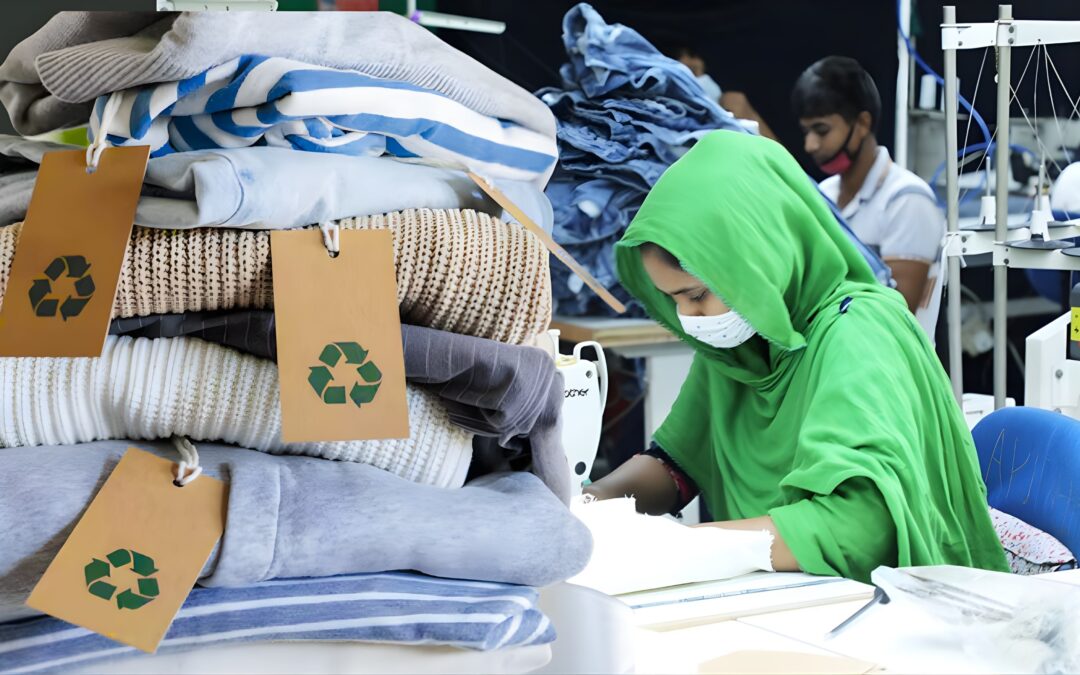
The Ready-Made Garment (RMG) industry has been pivotal to the economic development of Bangladesh. Accounting for over 80% of the country’s total export earnings, it is the second-largest garment exporter globally. However, it is also among the most polluting sectors in Bangladesh. The sector is responsible for 10% of the total carbon emissions of the country. In addition, workers employed in RMG factories continue to experience unsafe working conditions and low pay. Against this backdrop, the sector is under increasing pressure from the international community to adopt sustainable practices. The urgency to shift towards a green industry is driven by global climate commitments, trade agreements, and the need to maintain its competitiveness in the global market.
Key markets are increasingly imposing stringent conditions and standards. It is now imperative for Bangladesh to adopt green business practices to maintain and increase its export share in the RMG sector. Recent international agreements, such as the European Green Deal, the Corporate Sustainability Reporting Directive (CSRD), and the Corporate Due Diligence Directive (CSDDD), are notable initiatives undertaken as part of the journey towards building a sustainable future. Bangladesh’s ability to maintain its competitiveness is likely to be affected by the European Union’s push for a climate-neutral economy by 2050 and its mandatory corporate sustainability reporting. The sector risks facing higher tariffs and the loss of preferential trade access unless it moves toward sustainable practices.
Although the timeline is now uncertain, as Bangladesh will transition out of Least Developed Country (LDC) status in the near future, the urgency of adopting sustainable practices becomes even more critical. As the largest beneficiary of LDC-related trade preferences, more than 70% of Bangladesh’s export earnings rely on the tariff preferences accruing from its LDC status. Bangladesh’s apparel sector may be subject to 9.5% tariff, and unless it is able to meet the requirements set by EU, it also faces potential exclusion from GSP preferences in the EU market. This is in contrast to Bangladesh’s closest competitor in the RMG market, Vietnam, which enjoys a free trade agreement with the EU. Therefore, this potential increase in tariffs is likely to place Bangladesh’s apparel exports at a major disadvantage, given the EU’s high share as an export destination.
Current Sustainability Practices in Bangladesh’s RMG Sector
Driven by regulatory requirements and buyer demands, the RMG sector in Bangladesh has made significant progress in adopting sustainability practices over the last decade. There are now over 230 LEED (Leadership in Energy and Environmental Design) certified RMG factories in Bangladesh. This signals the sector’s continued commitment to controlling its environmental footprint. More factories are shifting towards energy-efficient machinery and waste-reduction techniques.
Various initiatives have also been taken to reduce pollution levels. To address water pollution and to reduce water waste, factories have implemented Effluent Treatment Plants (ETPs) and are increasingly focusing on rainwater harvesting. Many factories are switching to solar and other renewable energy sources to improve energy efficiency. The use of LED lights, energy-efficient sewing motors, and energy-saving technologies such as economiser systems, metering, generator chillers, and steam irons is becoming common in many exporting factories.
Following multiple tragic events in RMG factories, Bangladesh began its transition toward ensuring workplace safety and labour conditions, leading to the adoption of two notable initiatives- the Accord on Fire and Building Safety and the Alliance for Bangladesh Worker Safety. These steps have led to measurable improvements. For example, 56,000 fire, electrical, and building safety inspections were conducted at over 2,400 factories, leading to the resolution of 140,000 issues.
Gaps and Challenges
The intrinsic challenges of the RMG sector, combined with mounting pressure from global buyers to meet sustainability standards, make it imperative to align the industry with international standards. Despite making progress, the sector faces significant challenges in its journey towards full sustainability.
As a highly energy-intensive industry, RMG factories rely primarily on fossil fuels. The sector is responsible for 15.4% of the country’s total energy consumption. Reliance on outdated and inefficient equipment further adds to the energy consumption. Furthermore, the sector relies heavily on water. Factories engaged in dyeing and finishing processes use approximately 1,500 billion litres of water annually, which is five times higher than the global standard. Additionally, the wastewater generated from these processes is still not adequately treated, leading to river pollution and groundwater depletion.
Factories worldwide are moving towards circular production practices. However, the RMG sector in Bangladesh still generates 0.4-0.5 million tonnes of textile waste every year, most of which is cutting waste and fabric scraps. Although some circular practices such as recycling and upcycling have been adopted, the potential for reusing waste remains largely untapped. Many factories do not have either the equipment or the knowledge necessary to recycle materials or adopt comprehensive circular practices.
While the success of the RMG sector rests on the availability of cheap labour, the sector has yet to provide fair wages and safe working conditions to all its workers. Workers in Bangladesh earn one of the lowest minimum wages globally in the sector. Furthermore, despite women’s contribution in the progress of the sector, significant gender-based disparities remain. Compared to the male workers, females earn up to 30% less. Furthermore, they continue to be underrepresented in leadership roles.
The RMG sector is a priority area for Bangladesh, but it faces significant challenges in today’s global order. While compliance with the legislations provide opportunities to maintain and expand its market share, it also creates a myriad of complex issues. Although the adoption of energy-efficient technologies, water treatment systems and policy changes signal progress, much more needs to be done. The transition to sustainability practices has been uneven, with smaller factories falling behind. The restructuring of the sector in accordance with international guidelines requires significant investment, particularly for improving working conditions and ensuring better pay while moving towards net-zero and climate-positive production practices. Concerted efforts from all stakeholders- factories, global brands, government, and international donors is critical in helping Bangladesh’s RMG sector achieve its sustainability goals and ensuring its continued success in the global market.


















































RECENT COMMENTS