
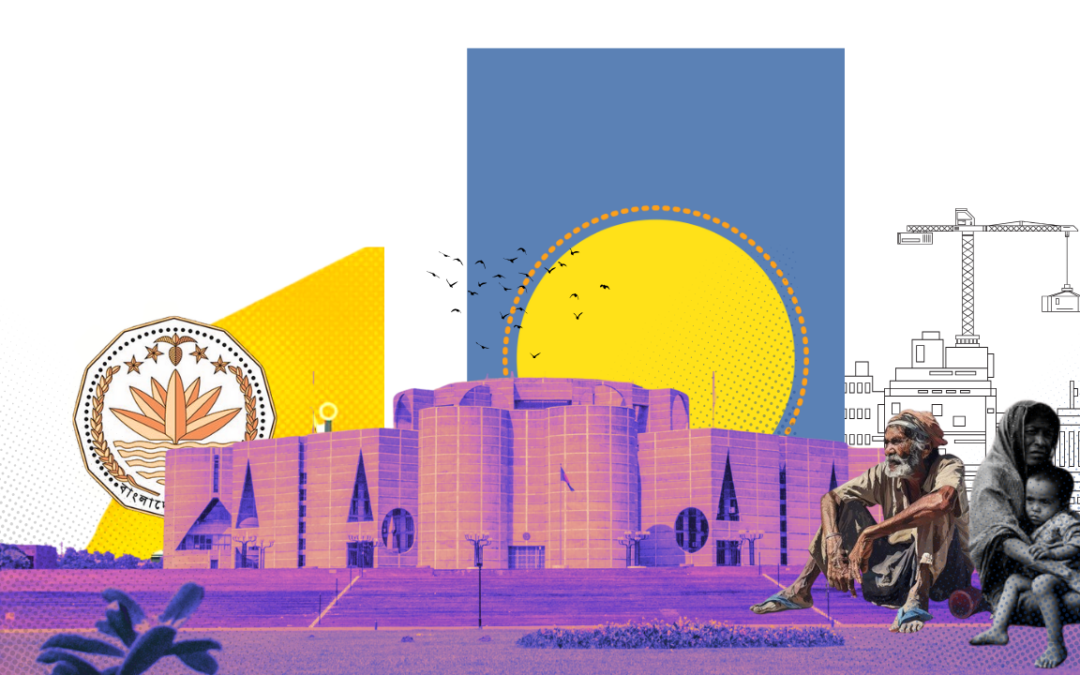
Introduction: Beyond recovery, towards purposeful growth
Bangladesh’s economy shows signs of stabilisation as reserves improve and imports ease, but this apparent calm obscures deeper weaknesses. Growth has slowed, inflation remains strikingly stubborn, investor confidence is still delicate, and long‑standing structural problems continue to sit on the economy. These challenges predated the political upheaval of 2024: Private investment was slowing, productivity growth decelerating, and dependence on a narrow export base deepening. The recent jolts were just the latest ones to lay bare vulnerabilities that had been built up over the years. As the LDC graduation in November 2026 is nearing, these pressures have been accentuated, and the economy finds itself caught in a low-growth trap where high prices dampen consumption, uncertainty discourages investment, and external demand continues to be weak.
Inflation is the most immediate burden for households. Even when headline figures soften, essential non‑food costs – housing, transport, healthcare, education – continue to rise. Real incomes have been squeezed as wages have lagged behind, making inflation a constant drag on living standards. And policy has been incomplete: from lagging tightening and continued liquidity support for weak banks, we have a toxic mix of high rates and sticky inflation that curbs investment without delivering price stability.
The financial sector is under severe strain. Non‑performing loans have climbed, asset quality has deteriorated, and capital buffers have thinned. This has restricted credit to productive firms, especially SMEs, undermining employment and growth. Measures such as mergers or liquidity injections offer temporary relief but do not address the governance failures at the root of the crisis.
Investment has also been weighed down by political uncertainty. Supply disruptions, increased informal costs, and laxer enforcement have heightened risks for businesses. The February 2026 poll is therefore economically critical: a credible transition would bring back predictability, attract investment, and make room for long-postponed reforms. Without it, stagnation may deepen.
The new government will have to do more than merely stabilise, and it must describe an economic development strategy that creates a million jobs, increases productivity, and broadens inclusion. Achieving this requires not only sound policies but also institutional credibility and political discipline.
The sections that follow outline the key economic priorities for the next government – drawing heavily on recent analyses and reform debates, but reorganised into a single, integrated narrative focused on action rather than diagnosis alone.
Restoring macroeconomic stability without suffocating growth
The first priority for the next government is to lock in macroeconomic stability while avoiding the trap of prolonged stagnation. Stability achieved at the cost of collapsing investment, falling real incomes, and shrinking public services is neither socially sustainable nor politically durable.
Inflation remains the most visible concern for households. While food inflation has eased, non-food inflation is still stubbornly high. This tells us something important. Inflation in Bangladesh today is not purely a demand-side phenomenon. This is due to supply bottlenecks, inadequate market supervision, energy price distortions, logistical inefficiency, and outright manipulation of important commodity markets in some instances.
It would be a mistake to rely solely on tight monetary policy to control inflation, and such a move may well do more damage than good. High rates drive up the cost of borrowing for producers, disincentivise private investment, and squeeze working capital, particularly for small and medium enterprises. Meanwhile, they don’t actually help to tackle the structural causes of inflation like food supply disruptions, elevated transport costs, or market imperfections.
The next government will have to adopt a more balanced anti-inflation policy. Attracting monetary restraint is indeed required, but it needs to be accompanied by well-focused supply-side interventions. Better food storage and logistics, strategic reserves of items like fertiliser and diesel, speeding up the process for allowing imports in time of shortage, tightening market monitoring – these can all do more to dampen price volatility than a hike in interest rates alone.
Exchange rate management is another sensitive area. The experience of recent years has shown that artificially defending the taka is costly and unsustainable. Limiting currency exchange rates to a more realistic, market-determined regime – one that moves in both directions –should encourage confidence, reduce the incentives for informal transfer, and support export competitiveness. The improvement in remittance inflows through formal channels offers a glimpse of what is possible when incentives are aligned with market realities.
Crucially, macroeconomic stability must not become an excuse for neglecting growth. A recovery in private investment is essential if GDP growth is to move beyond the current low trajectory. That recovery will depend less on macro indicators alone and more on confidence – confidence that policies are predictable, contracts are enforceable, and the cost of doing business will not spiral unexpectedly.
Reviving investment and production: from narrow engines to a broader base
Bangladesh has had a growth story over the past three decades driven largely by a few main engines: ready-made garments, remittances, and large-scale investment in infrastructure. This model delivered early gains, but its limitations are now increasingly apparent.
Export concentration is extreme. More than four-fifths of merchandise exports still come from garments. This leaves the economy highly exposed to shifts in global demand, changes in trade rules, labour and environmental compliance pressures, and technological automation. LDC graduation will only intensify these risks, as preferential market access gradually erodes.
The next government must therefore treat production diversification as an economic necessity, not a policy slogan. The focus should be on identifying sectors where Bangladesh already has a foothold and helping them scale up, rather than spreading incentives thinly across too many priorities.
Promising areas include pharmaceuticals, agro-processing, light engineering, ICT services, electronics assembly, medical supplies, and renewable energy components. In each case, the challenge is not a lack of entrepreneurs, but a lack of coordinated support – access to finance, quality infrastructure, standards and certification, skills, and market intelligence.
Industrial incentives must be redesigned in a way that recognizes performance rather than connections. Assistance should have a time frame, be transparent and related to specific outcomes such as export expansion, productivity increases, technology use or compliance enhancement. Support should be appraised and withdrawn if failing to meet targets. This discipline is essential if public resources are to catalyse learning and upgrading rather than entrench inefficiency.
Geography also matters. Industrial activity remains heavily concentrated around Dhaka and a few other urban centres, creating congestion, high living costs, and regional imbalance. The next government should prioritise regional industrial ecosystems, combining infrastructure, skills institutions, and SME clusters in selected districts. Well-functioning economic zones can play a role here, but only if bureaucratic delays, land issues, and utility constraints are addressed decisively.
Investment administration deserves special attention. Even after years of rhetoric about one-stop services, the investors are still up against an obstacle course of approvals and unpredictable delays. Transparent deadlines, digital tracking, silent approval processes, and credible appeals cannot be optional any longer. They are conditions for reviving investment momentum.
Fixing public finances: revenue mobilisation as a development imperative
Few issues are as central to Bangladesh’s economic future as public finance. The country’s tax-to-GDP ratio has fallen to one of the lowest levels globally, leaving the state with dangerously limited fiscal space. At the same time, fixed expenditures – salaries, pensions, interest payments – consume the bulk of available revenue, crowding out spending on development and social services.
The result is visible everywhere. Public investment has been cut back sharply. Spending on education, health, water, and social protection remains far below what is needed for inclusive growth. This is not a sustainable equilibrium.
The next government must therefore place domestic resource mobilisation at the heart of its economic strategy. This is not simply about raising taxes. It is about building a fair, predictable, and credible revenue system that citizens and businesses can trust.
Broadening the tax base is essential. Too much of the burden falls on a narrow segment of formal firms, while many high-income individuals and large informal businesses remain outside the net. Reducing discretionary exemptions, simplifying tax laws, and digitising filing and payment systems can improve compliance while lowering harassment and arbitrariness.
Institutional reform of tax administration is equally important. Predictability matters as much as enforcement. When rules are clear and consistently applied, voluntary compliance improves. When enforcement is perceived as selective or punitive, evasion becomes rational.
Property taxation, especially in urban areas where land values have soared, offers a largely untapped source of revenue. Properly designed, it can also support better local services and urban planning. Reforming state-owned enterprises is another opportunity. Many continue to absorb public resources through operating losses that could be reduced with better governance and pricing reforms.
On the spending side, fiscal prudence needs to be accompanied by a reprioritisation. Subsidization of energy, export, and remittances, as well as inefficient transfers would need to be re-examined in the context of a more market determined exchange rate. Savings must be redeployed to health, education, water, and targeted social protection – all of which yield long-term returns in terms of productivity and resilience.
Repairing the financial sector: restoring trust and credit flow
A weak financial system can no longer support a growth strategy, and Bangladesh cannot ignore this fact. It was several years of increasing strain before banking reached the situation we saw in 2024: nonperforming and distressed loans at very high volumes, weak governance, and public trust battered. Efficient companies found it hard to get affordable credit, while politically favorable borrowers frequently defaulted without punishment. The distortion of investment incentives was not only outrageous, but it dented the credibility of the whole financial system.
In response, Bangladesh’s banking sector is now undergoing the most serious reform effort in decades, supported by international partners and anchored in a recognition that business as usual is no longer viable. A cornerstone of this work has been reinforcing the legal and regulatory arsenal to resolve ailing banks. The Bank Resolution Ordinance 2025 provided the central bank with a more explicit mandate to intervene early, appoint administrators, effect mergers, and resolve troubled institutions in an orderly manner. Alongside this, the Deposit Protection Ordinance 2025 has expanded depositor coverage, helping to stabilise confidence and reduce the risk of panic in times of stress.
Supervision is also being overhauled. Asset Quality Reviews of major private banks are underway to uncover hidden losses and bring balance sheets closer to reality, with state-owned banks expected to follow. The shift toward risk-based supervision, supported by a major internal reorganisation within the central bank, is intended to move oversight away from box-ticking and toward early identification of vulnerabilities. These have been accompanied by governance reforms, such as the reconstitution of boards in some banks to lessen political pressure and increase accountability.
Non-performing loans are still the most difficult issue to solve. Tightened definitions of overdue loans and changes in rules regarding wilful defaulters are expected to cut down on cosmetic rescheduling and enhance transparency. At the same time, task forces are in the works to trace and seek recovery of laundered money – but success on this front will ultimately depend upon effective legal enforcement and institutional coordination.
These reforms are still fragile. Entrenched NPLs, pressure on central bank independence, and resistance within parts of the system continue to pose risks. Much will depend on whether interference in regulatory decisions can be credibly reduced and whether reforms are sustained beyond the immediate crisis.
Looking ahead, stabilisation must translate into renewed credit flow for productive investment. Resolution mechanisms should protect depositors, not shareholders who benefited from misgovernance. At the same time, the financial system must be better aligned with development needs. Long-term finance for infrastructure, green investment, and innovation remains scarce. Well-governed development finance instruments, credit guarantees, and bond markets can help bridge this gap—but only if the hard-won momentum on banking reform is maintained.
Employment, skills, and the youth challenge
Bangladesh’s demographic profile presents both opportunity and risk. A large working-age population can be a powerful engine of growth, but only if jobs are created at scale and skills keep pace with economic change.
At present, the labour market tells a troubling story. Employment growth has slowed. Underemployment is widespread. Educated youth face particularly bleak prospects, feeding frustration and social tension. Informality remains the norm, limiting security and productivity.
The next government must place employment at the centre of economic policy, not as a by-product of growth but as an explicit objective. This means prioritising labour-intensive sectors, supporting micro and small enterprises, and investing heavily in skills development.
Training systems are a glaring weak point. Fewer than one in a hundred workers has received formal training. This is a policy failure of long standing. Fixing it will require partnerships between government, industry, and training providers, with curricula aligned to labour market demand and overseas opportunities.
Reducing the cost and risk of overseas migration, improving pre-departure training, and curbing exploitation by intermediaries can also expand employment options while boosting remittance income.
Youth engagement must go beyond employment alone. Creating platforms for participation, service, and civic engagement can help channel energy and aspirations into constructive pathways. The events of recent years have shown that young people want a voice. Ignoring that reality carries economic as well as political risks.
Social protection and inequality: investing in resilience
Economic growth that bypasses large sections of society cannot be sustained for long. In Bangladesh, the weaknesses of the social protection system are no longer a marginal policy concern; they are a central economic constraint. Programmes remain fragmented, funding is inadequate, coordination is weak, and coverage is uneven. Urban vulnerability is rising quickly, yet most safety nets are still designed with a rural bias. When shocks hit, many households fall through the cracks, amplifying poverty, insecurity, and social stress.
The next government should therefore treat social protection as a core economic investment rather than a residual welfare obligation. The priority is not simply to add new programmes, but to reorganise existing ones around a clear lifecycle framework. The support to children, working-age individuals affected by shocks, persons with disabilities, and older people must be coherent, predictable, and adequately resourced. Better targeting, which uses integrated household data frequently updated, can make programs more effective and reduce leakage and exclusion.
Urban food security deserves particular attention. Rising food prices, irregular incomes, and high housing costs have made many urban households extremely vulnerable, even when they do not fall below official poverty lines. Bringing these households into food distribution mechanisms can stabilise consumption, reduce distress, and support overall macroeconomic stability during periods of inflation or supply disruption. Digital delivery systems can help, but only if they are inclusive, transparent, and accessible to those with minimal digital literacy.
Tackling inequality also hinges on access to good-quality public services. Education and health outcomes in Bangladesh are shaped as much by planning failures and staffing gaps as by budget allocations. Investments have all too often focused on buildings and equipment rather than teachers, health workers, supervision, and accountability. Without tackling these human and institutional elements, merely spending more money will yield diminishing returns.
Thus, a stronger social protection system will have to be accompanied by continued investment in and growth of education and health systems serving the people. Those who feel shielded from shocks and have access to dependable services are more likely to invest in skills, take productive risks, and engage in an economy. This underpins inclusive growth.
Trade, LDC graduation, and global positioning
As Bangladesh approaches graduation from Least Developed Country status in 2026, trade policy is no longer a technical afterthought. It is becoming one of the main arenas in which the country’s future growth path will be determined. Graduation is a genuine achievement, but it also removes the protective layer that quietly supported export success for decades. Preferential market access will fade, compliance demands will tighten, and competition will become sharper, often in ways that are not immediately visible but deeply consequential.
The challenge is clear. Bangladesh needs to learn to compete without special treatment, but without losing jobs or export earnings, or macroeconomic stability during the transition. It requires moving from preferences and protection when it comes to trade, towards a trade regime underpinned by competitiveness, predictability, and greater integration in regional and global markets.
Exports remain heavily concentrated, with ready-made garments dominating both earnings and participation in global value chains. Preferential access has masked weaknesses in logistics, customs, standards, and trade facilitation. Graduation will slowly take that cushion away. Exports may not collapse overnight, but the margin for error will narrow sharply. Bottlenecks at ports, erratic customs practices, abrupt adjustments to tariffs, or lax enforcement of standards will increasingly result not in added costs that can be absorbed on margins but in lost contracts.
Competitiveness must therefore be treated as a system-wide issue. Exchange rate management matters, but it is only one piece of the puzzle. Reliability, speed, regulatory clarity, standards infrastructure, and firm capabilities will matter just as much. In a post-LDC environment, success will depend not only on price, but on consistency and the ability to upgrade products and processes.
A central weakness in Bangladesh’s trade regime is its strong anti-export bias. High tariffs, para-tariffs, and discretionary duties have always driven companies towards protected domestic markets. As preferences erode, this structure will become increasingly costly. Exporters will face higher input prices and weaker incentives to diversify, while protected sectors will struggle to deliver productivity gains or foreign exchange.
The next government should therefore embark on a phased but viable rationalisation of tariffs, bringing trade policy in line with export aspirations. The objective is not for an instantaneous liberalisation, but rather simpler, more transparent systems that permit exporters to obtain inputs at world prices. Policy stability is critical. Frequent, discretionary changes discourage long-term investment and undermine confidence.
Trade facilitation will be decisive. For many exporters, domestic inefficiencies are more important than foreign tariffs. Delays caused by port congestion, slow clearance, and poor coordination among border agencies incur cost and create uncertainty. Even minor delays can send orders to other parts of tightly managed global supply chains. Competitiveness benefits of a large scale can be achieved through measures such as single-window systems, risk-based controls, electronic documentation, and enhancing logistics connectivity.
Export diversification is no longer optional. Relying on a single sector to generate jobs and foreign exchange exposes the economy to shocks it cannot absorb. Diversification does not mean abandoning garments, but deliberately broadening the export base. Support should be focused on a limited number of promising sectors and firms, linked to performance and time-bound. Backward linkages deserve priority to deepen and reduce import dependence.
Climate, rural development, and long-term sustainability
The threat of climate vulnerability is not a far-off prospect anymore. Today, it is determining livelihoods, migration, and public spending. The next government will have to embed climate adaptation and mitigation into the heart of mainstream economic planning.
Rural development deserves renewed focus. Expansion purely through mega projects and sprawl will do nothing to address the waterlogging, unemployment, or social stress in the countryside. Comprehensive local development models integrating infrastructures, livelihoods, services, and environmental management can achieve more balanced results.
Green investment, renewable energy, and climate-resilient agriculture are not just environmental priorities. They are economic opportunities that can generate jobs and reduce long-term costs.
Conclusion: Choosing direction, not drifting
The next government in Bangladesh will inherit an economy that is more stable than it was two years ago, but also more fragile in its foundations. Stabilisation has bought time. It has not solved the deeper problems of weak investment, limited job creation, fiscal stress, and inequality.
The economic priorities outlined in this article point to a clear direction. Restore confidence. Broaden the production base. Mobilise domestic resources. Repair the financial system. Put jobs, skills, and social protection at the centre of policy. Prepare seriously for a post-LDC world. And embed climate resilience into development planning.
None of this will be easy. Vested interests will resist change. Administrative inertia will slow progress. Mistakes will be made. But the alternative – drifting back into business as usual – carries far greater risks.
Bangladesh has reached a moment where choices matter more than promises. If the next government is able to act with clarity, discipline, and inclusiveness, it can break free from crisis management and build a more sustainable path of growth that promotes equality. If it can’t, the price won’t be measurable in derivative indicators, but in a lack of opportunities for millions of people whose aspirations go unmet.












































RECENT COMMENTS