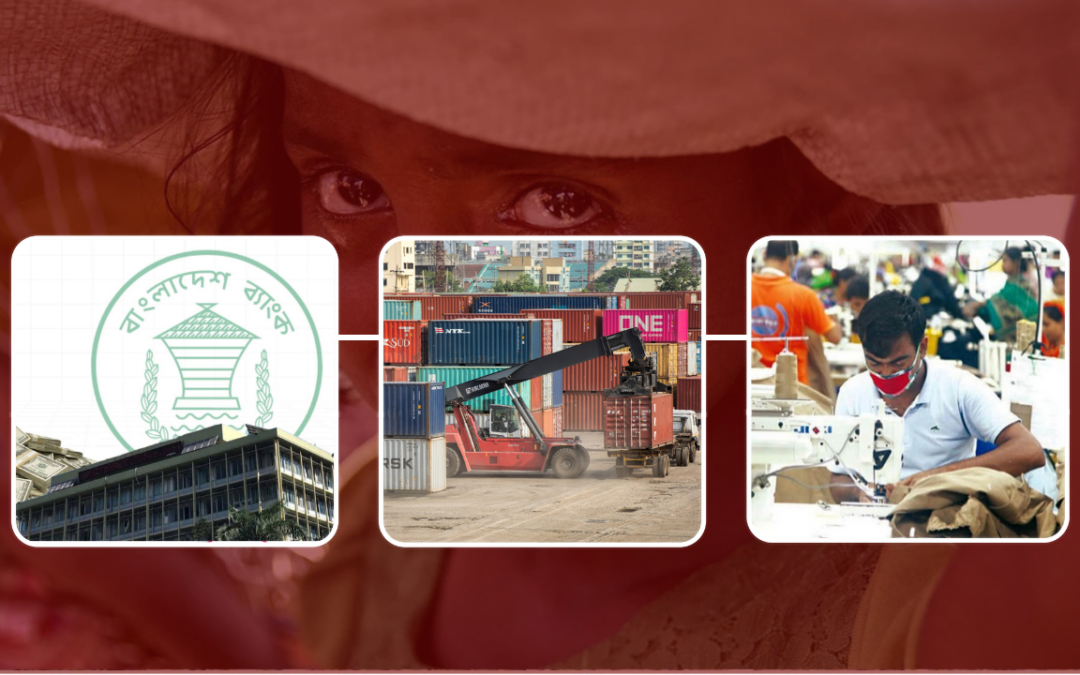
Bangladesh’s economy seems to be stabilizing at first blush. Reserve levels have climbed, imports have slowed, and officials are finding some signs of resilience in the aftermath of a tumultuous period. For a country accustomed to absorbing shocks, this narrative of cautious recovery sounds reassuring.
But this calm is deceptive. Below the surface, there is slow growth, stubbornly high inflation, fragile investor confidence, and deep cracks in the financial system. This slowdown did not start with the current political troubles. Growth was already losing momentum prior to the upheavals of 2024. Private investment had already stagnated, productivity gains were weakening, and the economy was becoming increasingly dependent on a narrow export base. The recent shock merely exposed vulnerabilities that had been accumulating quietly for years. With the country on course to graduate from LDC status in 2026, these weaknesses matter more. The result is an economy caught in a low-growth equilibrium. Consumption is constrained by high prices. Investment is held back by uncertainty and financial stress. Exports face headwinds from global demand, tariffs, and intensifying competition. Growth has not collapsed, but neither has it found a new engine.
Inflation and the Erosion of Everyday Life
Inflation remains the most visible pressure point. While headline figures have eased marginally at times, the lived experience tells a harsher story. Non-food inflation is high and persistent. Rents, transport costs, healthcare, and education expenses continue to rise, squeezing urban households in particular.
But wages, meanwhile, have not kept up. For many workers, particularly in informal and service jobs, real incomes have fallen. This erosion of purchasing power has turned inflation into a silent tax on the majority of households. It also explains why modest improvements in macro indicators have not translated into public relief.
The policy response has been conflicted. Tight monetary conditions were necessary, but their delayed application blunted their effectiveness. Meanwhile, liquidity provision to troubled banks has been diluting disinflationary pressure, keeping costs elevated. The result is an uncongenial equilibrium of high interest rates and high inflation, which suppresses investment but does not definitively restore price stability.
A Financial System Under Severe Stress
The most alarming fault line runs through the financial sector. Non-performing loans have risen to levels unmatched in the region. In banks and non-bank financial institutions alike, asset quality has deteriorated sharply, capital buffers have eroded, and confidence has weakened.
This is not merely a technical banking problem. It is a structural constraint on growth. When banks are burdened with bad loans, credit for productive firms dries up. Small and medium enterprises, which generate most employment, are the first to be squeezed out. High interest rates matter, but access to finance matters even more, and for many firms, that access has narrowed dramatically.
The proposed responses have been mixed. Bank mergers and liquidity injections may protect depositors in the short term, but they do little to address the deeper governance failures that produced the crisis. Without transparency, credible enforcement, and a clear break from the culture of repeated rescheduling and implicit bailouts, the system risks recycling the same problems under new institutional labels.
Political Uncertainty, Law and Order, and the Investment Freeze
There is also a factor that economists sometimes understate because it is difficult to quantify, yet investors treat it as decisive: political uncertainty and the resulting deterioration in the everyday governance environment. Investment does not only respond to interest rates, exchange rates, or tax policies. It responds to predictability. And in recent years, predictability has been in short supply.
When businesses see frequent disruptions on the streets, rising informal “costs” in supply chains, or a weakening of ordinary law and order, they behave rationally. They postpone expansion, delay hiring, hold cash, and reduce exposure. This is how uncertainty turns into an investment freeze. It also helps explain why, even when some macro indicators look slightly better, the private sector still appears reluctant to move fast.
The broader drift toward mobocracy, or the perception that rule enforcement is uneven and sometimes replaced by informal power, has real economic consequences. It raises transaction costs, weakens contract enforcement, increases risk premiums, and undermines the credibility of regulatory decisions. In simple words, it makes long-term planning feel unsafe.
Why the February 2026 Election Matters Economically
This is why the general election scheduled for February 2026 is not just a political milestone. It is an economic inflection point. A credible transition can restore a baseline of legitimacy that helps public institutions function more predictably. That, in turn, can rebuild confidence, improve the law-and-order environment, and reduce the uncertainty that has pushed investors into a defensive posture.
A genuine transition also matters because it can create space for reforms that are economically necessary but politically difficult. Banking sector cleanup, stronger enforcement against loan default, rationalisation of tax policy, and the rebuilding of regulatory independence require political backing. Without that backing, reforms remain half-hearted, and half-hearted steps rarely convince markets.
If the election produces a peaceful and widely accepted outcome, it could unlock deferred investment decisions. Domestic businesses may restart stalled expansion plans. Foreign investors may revisit a market they have been watching from the sidelines. Credit conditions could improve, not only through policy signals but through renewed confidence in institutions. None of this is automatic, but it becomes possible.
But if the election only heightens uncertainty or does nothing to re-establish public order and restore institutional credibility, the economy may remain mired in stagnation for some time. In that case, even a strong-holding improvement in reserves would evidence compression and not strength, and lower readings of inflation would not result in true relief.
Prospects for 2026: Recovery or Prolonged Fragility?
Looking ahead to 2026, the outlook remains finely balanced. Recovery is possible. Reserves have improved. Remittances remain resilient. Certain infrastructure investments could generate momentum. A clearer political settlement after February 2026 could revive confidence and restore the basic predictability that markets need.
But none of this is guaranteed. Persistent inflation, a weakened financial system, limited fiscal space, and global uncertainty form a tight constraint. Graduation from LDC status will raise the stakes further, exposing unresolved weaknesses rather than masking them. The central question, then, is not whether the economy is collapsing. It is whether Bangladesh can break out of stagnation and rebuild a growth model that is more diversified, more transparent, and more inclusive, under a governance environment where rules matter, and public authority is credible. For now, the evidence suggests an economy that is surviving, not thriving. Whether 2026 becomes a turning point will depend heavily on whether the political transition restores order, reduces uncertainty, and persuades investors that the future is brighter.



















































RECENT COMMENTS